

Key Takeaways
A suspension issue rarely announces itself with one perfect symptom. A careful inspection, correct part matching, and a post-repair alignment are usually more valuable than choosing the most aggressive upgrade.
- Suspension components work together to control comfort, tire contact, and handling.
- Front and rear layouts use different parts and should not be treated as interchangeable.
- Noises, tire wear, ride height, and steering changes can point toward developing faults.
- Model year, drivetrain, wheels, tires, and vehicle weight all affect fitment and behavior.
- Suspension upgrades should include alignment checks and appropriate safety inspections.
Understanding the Tesla Model Y suspension system
The suspension connects the body to the wheels while allowing each wheel to respond to bumps and changes in road surface. It also helps maintain tire contact during braking, cornering, and acceleration. That makes suspension condition relevant to both comfort and predictable control, not just the absence of noise.
A useful starting point is the vehicle’s factory layout and the way the car is used. A daily commuter carrying passengers has different priorities from a frequently loaded vehicle or one driven on rough roads. The broader context around Tesla’s vehicle development can be found in this overview of Tesla’s innovation strategy, although suspension decisions still need to be made from the individual vehicle’s specification and condition.
How the suspension supports ride quality and handling
Springs support the vehicle’s weight, while dampers control how quickly the body and wheels move. Links, arms, and bushings guide that movement and absorb small amounts of vibration. When those pieces are working together, the car can feel settled without becoming harsh over ordinary road imperfections.
Ride quality is not the same as softness. Too much movement can delay the vehicle’s response, while excessive stiffness can reduce comfort and make uneven pavement more intrusive. The goal is controlled wheel movement, consistent tire contact, and steering behavior that does not change unexpectedly.
Differences between front and rear suspension layouts
The front suspension must accommodate steering as well as vertical wheel movement, so its arms, knuckles, joints, and alignment adjustments have a direct relationship with steering feel. The rear suspension does not steer in the same way, but its links still control wheel position, toe, and camber as the suspension moves.
This distinction matters when diagnosing a noise or ordering a part. A similar-looking arm from one end of the vehicle may have a different bend, bushing orientation, mounting point, or alignment function from an arm at the other end. Always identify the exact position before comparing replacement options.
How AWD and RWD configurations can affect component selection
All-wheel-drive and rear-wheel-drive versions can share many suspension principles, but their driveline hardware, weight distribution, calibration, and factory specifications may differ. Those differences can affect clearance, spring or damper choices, and the correct alignment targets.
Use the vehicle identification number, model year, trim, and drivetrain when checking fitment. If a listing says it fits every version, verify that statement against the manufacturer’s application data rather than assuming that a shared body shell guarantees compatibility.
Why wheel size, tire choice, and vehicle weight matter
A larger wheel and a lower-profile tire generally leave less tire sidewall to absorb sharp impacts. Tire construction, inflation pressure, cargo, passengers, and accessories also change the forces reaching the suspension. These variables can make the same replacement part feel quite different from one vehicle to another.
Before blaming a component, confirm the tire pressures and inspect the tires for damage or irregular wear. Suspension work should be evaluated with the intended wheel-and-tire package installed, because changing that package can alter ride height, steering response, and perceived harshness.
Key Tesla Model Y suspension components
The main Tesla Model Y suspension components form a chain of load-bearing and motion-controlling parts. An arm may locate the wheel, a bushing may permit limited movement, and a damper may control the speed of that movement. A fault in one part can place extra stress on neighboring components.
It helps to think in systems rather than isolated replacements. A worn bushing, for example, may create alignment changes that are felt as a tire-wear problem. The most useful replacement decision follows the observed symptom back to the failed part instead of replacing everything nearby without evidence.
Control arms, ball joints, and bushings
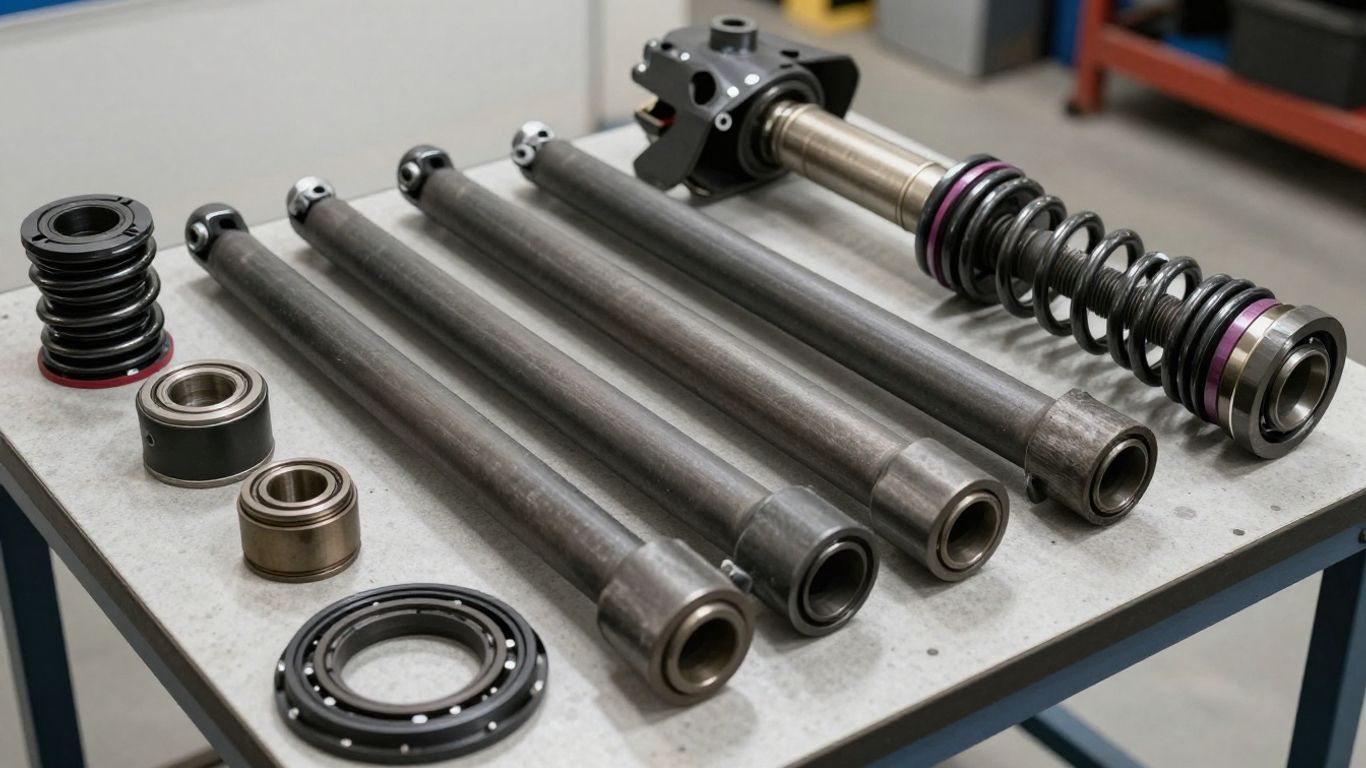
Control arms locate the wheel assembly relative to the body, while ball joints allow angular movement as the suspension travels and the front wheels steer. Bushings cushion the connection and permit carefully limited flex. Cracks, separation, deformation, or looseness can affect both noise and alignment.
A damaged dust boot deserves attention because contamination can accelerate joint wear. For a more technical reference, this Model Y suspension inspection guide discusses inspection considerations for ball joints and bushings. Its procedures are more useful than guessing from a photograph alone.
Struts, shocks, and coil springs
The coil spring carries much of the vehicle’s static load and contributes to ride height. The damper, often called a shock absorber or strut assembly depending on its role, controls compression and rebound. A leaking damper, broken spring, or visibly uneven ride height can change how the vehicle responds to bumps and turns.
The terms are sometimes used loosely in parts listings, so read the application carefully. A complete assembly may include several pieces that are sold separately, and the correct installation method can depend on whether the spring is already contained in the assembly.
Stabilizer bars, links, and mounts
A stabilizer bar connects suspension movement across the vehicle to help limit differences in body roll during cornering. Its links and mounts transmit those forces, making their bushings and fasteners common places to inspect when a noise appears over small bumps or while entering a driveway.
These parts do not carry the same function as a spring or damper. Replacing a noisy link may quiet the vehicle without changing its basic ride height, while a bar or bushing change can affect roll balance. The intended result should be clear before selecting a higher-rate component.
Knuckles, hubs, and wheel bearings
The steering knuckle or rear carrier provides a structural connection for suspension and wheel-related hardware. The hub supports the wheel, and the bearing allows rotation with minimal friction. Damage from an impact, corrosion, or bearing wear can produce vibration, play, or a humming sound that changes with speed.
Because these parts sit close to the wheel and brake assembly, diagnosis should include a check for bent components and wheel damage. A bearing noise can resemble a tire problem, while a tire problem can be mistaken for a bearing, so road-test observations should be paired with a physical inspection.
Common suspension problems and warning signs
Suspension symptoms often overlap with wheel, tire, brake, and steering faults. A single clunk does not identify a failed arm, and a pull does not automatically mean a damaged suspension component. The pattern, timing, road surface, and inspection findings matter together.
Record when the symptom occurs: during braking, acceleration, turning, one-wheel bumps, or steady highway driving. That small amount of detail gives a technician a better starting point and can prevent unnecessary parts replacement.
Clunking, knocking, and other unusual noises
A clunk over a sharp bump may come from a loose connection, worn link, deteriorated bushing, or play in a joint. A creak can have a different cause from a metallic knock, while a humming sound that rises with road speed may point toward a wheel or tire concern rather than a suspension link.
Try to notice whether the noise occurs on one side, with steering input, or only when the suspension moves at low speed. Do not crawl under a vehicle supported only by a jack. Safe support and a controlled inspection are more important than reproducing the noise at home.
Uneven tire wear and alignment symptoms
Feathering, cupping, inner-edge wear, and a difference between left and right tires can indicate alignment or damping problems. They can also result from incorrect pressure, tire imbalance, worn steering parts, or normal differences in road loading. Tire wear is a clue, not a diagnosis.
If wear is progressing quickly, measure alignment rather than waiting for the next tire replacement. The readings can reveal toe or camber changes and help determine whether a component is bent, loose, or simply out of adjustment.
Excessive bouncing, sagging, or body movement
A vehicle that continues to bounce after a bump may have reduced damping, though tire pressure and spring condition should also be considered. Sagging at one corner can suggest a damaged spring, a change in load, or a component that is no longer supporting the vehicle as intended.
Compare ride height on level ground with similar fuel, cargo, and tire-pressure conditions. A visual difference is worth investigating, but measurements are more reliable than judging from a sloped driveway or uneven pavement.
Steering pull, vibration, and changes in handling
A pull may be caused by alignment, tire conicity, braking drag, road crown, or a suspension part that has shifted. Vibration at a particular speed often leads the investigation toward wheel balance, tire condition, or a bent wheel, while vibration under braking may involve the brake system.
Changes in handling deserve prompt attention when they appear suddenly. If the vehicle wanders, the steering wheel no longer returns normally, or a tire shows rapid wear, reduce unnecessary driving and arrange an inspection before selecting replacement parts.
How to diagnose suspension component issues
Diagnosis should move from simple observations to targeted checks. Start with tire condition, ride height, visible damage, and the circumstances of the symptom. Then inspect the relevant joints and mountings using suitable equipment and safe working practices.
Avoid replacing a complete corner based only on age or a vague noise. A measured finding—such as visible fluid leakage, unwanted play, or a separated bushing—creates a much stronger case for a specific repair.
Performing a basic visual inspection
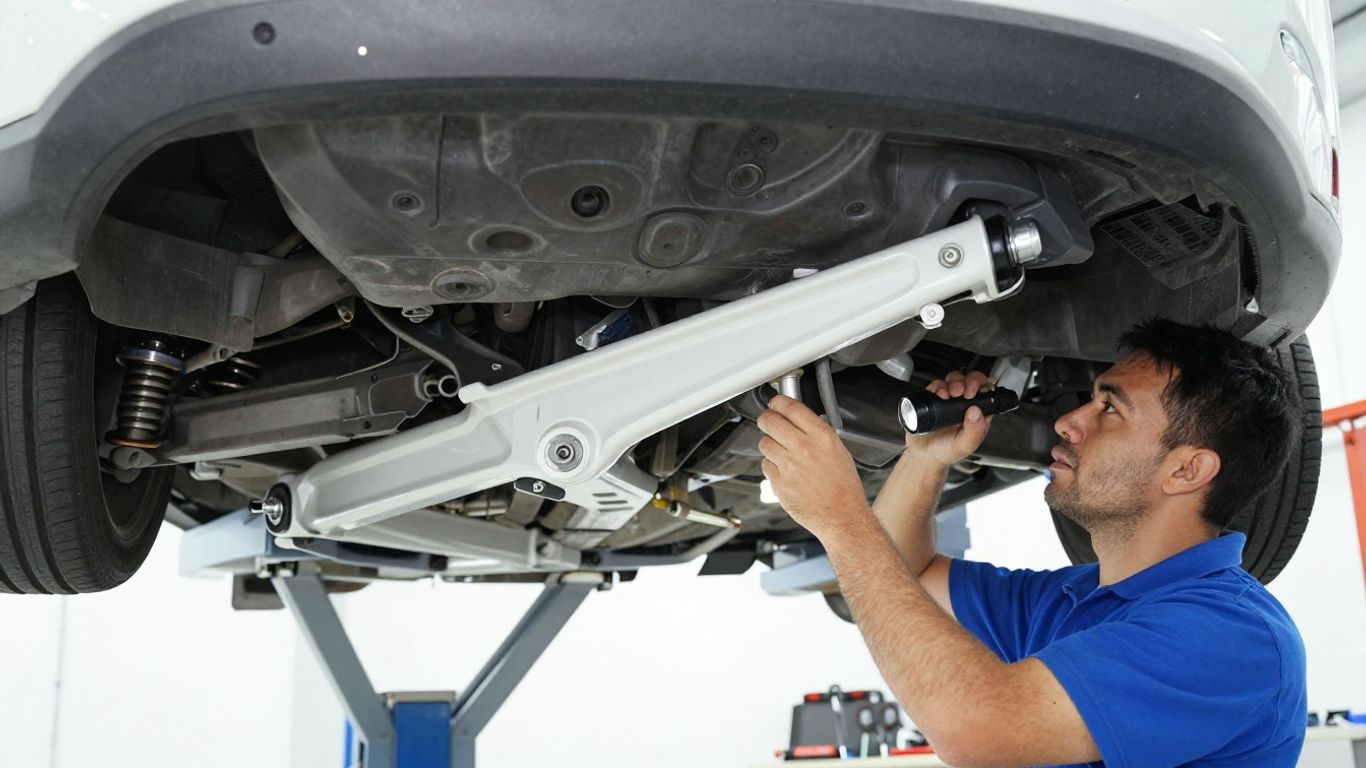
Park on a level surface and compare the left and right sides. Look for leaking damper fluid, a broken or displaced spring, torn dust boots, damaged bushings, bent metal, loose-looking hardware, and contact marks around the wheel or tire. A flashlight can reveal details that are easy to miss in low light.
Inspect the tire and wheel at the same time. A bulge, impact mark, or uneven tread pattern may explain the symptom independently of the suspension. Visual inspection cannot prove that a part is sound, but it can identify reasons to stop driving and seek help.
Checking for play, leaks, and damaged bushings
Unwanted play should be checked with the vehicle supported correctly and with the appropriate tools and procedure. A technician may load the suspension, move the wheel in different directions, and inspect joints while watching for movement. Damper leakage should be distinguished from harmless residue or contamination from another source.
A practical inspection sequence keeps the findings organized:
- Confirm tire pressure, wheel condition, and visible tread wear.
- Check for fluid leakage around dampers and nearby components.
- Inspect ball-joint boots, arm bushings, and stabilizer-link connections.
- Check wheel and suspension play with safe support and suitable equipment.
This sequence does not replace a service procedure, but it helps separate obvious concerns from symptoms that need measurement. If a check requires force, disassembly, or access beneath the vehicle, stop when the equipment or support is not adequate.
Using tire wear and ride height as clues
Measure ride height consistently, using the same reference points on both sides and recording the wheel-and-tire setup. Compare the pattern with tire wear and the driver’s description. A low corner, for example, deserves a different line of inquiry from a symmetrical change caused by added cargo.
Photographs and notes can be surprisingly helpful. Record tread depth across the tire, the location of any noise, and whether the symptom changes with speed or steering angle. These details make a later professional inspection more efficient.
When to schedule a professional inspection
Arrange an inspection promptly for severe looseness, a broken spring, a damaged joint boot with suspected play, sudden handling changes, fluid leakage, or any component that may be bent. A professional shop can use a lift, pry tools, alignment equipment, and manufacturer-specific procedures that are difficult to duplicate at home.
A suspension service reference can help explain what technicians inspect, but it is not a substitute for the correct repair procedure. Stop driving if steering control is compromised, a tire is contacting the body, or a wheel assembly appears unstable.
Choosing replacement Tesla Model Y suspension components
Replacement decisions should begin with identification, not appearance. Confirm the model year, trim, drivetrain, suspension configuration, and whether the vehicle has been modified. Then compare the failed part’s position and function with the proposed replacement.
There is no universal “best” component for every driver. A quiet, durable daily-driver repair may call for a different specification from a setup intended to change ride height or cornering response. The useful choice is the one that fits the vehicle and the intended use without creating new problems.
OEM parts versus aftermarket alternatives
Original-equipment replacement parts are designed around the vehicle’s factory application, while aftermarket parts may target price, serviceability, durability, comfort, adjustability, or performance. Neither label alone proves that a part is correct for a particular repair.
Read the application details, included hardware, installation instructions, and warranty terms. For broader browsing, the aftermarket suspension selection shows the types of components commonly offered for Model Y customization, but the buyer still needs to verify exact fitment and intended use.
Matching components to model year and drivetrain
Fitment can change across production years, trims, drive configurations, wheel packages, and factory ride heights. Check part numbers rather than relying only on a vehicle name in a search result. If the vehicle has adaptive or electronically monitored equipment, confirm whether additional compatibility steps are required.
Keep the old part until the replacement has been compared physically and by part number. This simple habit can expose differences in mounting points, connector locations, bushing orientation, or supplied fasteners before the vehicle is disassembled further.
Evaluating materials, fitment, and manufacturer quality
Look for clear dimensional and application information, consistent manufacturing details, protective finishes where appropriate, and instructions that explain torque or installation requirements. Bushings, seals, springs, and bearings deserve particular attention because material quality can affect noise, longevity, and feel.
Reviews can reveal recurring fitment issues, but they should not outweigh documented specifications. A part that requires forcing, drilling, improvised spacers, or unexplained changes is a warning sign unless those steps are explicitly part of a professionally supported installation.
Balancing cost, durability, and warranty coverage
The cheapest part can become expensive if it fails early, damages a tire, or requires a second alignment. At the same time, an expensive upgrade may not offer value for a vehicle that only needs a standard repair. Compare total cost, including labor, alignment, related hardware, and possible follow-up adjustments.
Warranty length is only one factor. Check what is covered, who handles the claim, whether installation by a qualified professional is required, and whether the warranty applies to modified vehicles. A clear return policy is useful when fitment has not been confirmed.
Tesla Model Y suspension upgrades and installation considerations
Upgrades change more than one isolated characteristic. Lowering a vehicle can alter travel and alignment range, while firmer damping or sway control can change comfort and handling balance. Before buying, define whether the priority is appearance, reduced body roll, sharper response, restored comfort, or adjustability.
The surrounding setup matters too. Wheel offset, tire sidewall, alignment settings, cargo, and road quality can determine whether a modification feels composed or unnecessarily harsh. Treat an upgrade as a complete system change rather than a single advertised number.
Lowering springs, coilovers, and comfort-focused kits
Lowering springs change static ride height and usually reduce available bump travel. Coilovers add adjustability, but that flexibility also creates more setup decisions and more opportunities for an unsuitable adjustment. Comfort-focused kits may prioritize controlled movement and reduced harshness rather than the lowest possible stance.
The right choice depends on road conditions and tolerance for maintenance or setup work. Check spring rates, damper adjustment range, expected ride height, clearance, included hardware, and whether the kit is approved for the exact vehicle configuration before installation.
Performance sway bars and handling upgrades
A higher-rate stabilizer bar can reduce body roll, but it may also change how the front and rear axles share cornering work. Links, mounts, bushings, and fasteners must be suitable for the new loads. Handling changes should be evaluated as a balance, not judged only by a reduction in lean.
For an AWD vehicle, available AWD suspension upgrade parts illustrate how fitment may be organized around drivetrain-specific applications. That kind of application detail is more useful than assuming a part intended for one configuration will behave identically on another.
Alignment requirements after suspension work
Any work that changes control-arm position, ride height, bushings, links, or knuckle location can affect alignment. Have the vehicle checked on suitable equipment after installation, and ask for the measured before-and-after readings. A correct-looking steering wheel does not guarantee correct toe or camber.
Alignment should also be reassessed after the suspension settles, when the manufacturer or installer specifies it. Uneven tire wear, a pull, or a new steering sensation after an upgrade is a reason to return for measurement rather than simply adjusting tire pressure.
Safety checks and when professional installation is recommended
Spring removal, suspension loading, and work near wheel hubs require proper tools and support. Follow torque procedures, replace one-time-use hardware when specified, route cables and hoses safely, and verify that nothing contacts the tire through the full range of movement. A short road test should follow a stationary inspection.
Professional installation is the sensible choice when compressed springs, electronic compatibility, seized fasteners, bent parts, or alignment changes are involved. General advice about handling upgrades can help frame a project, but it does not replace a vehicle-specific installation check.
Conclusion
Choosing and maintaining Tesla Model Y suspension components is mostly an exercise in careful identification: listen to the symptom, inspect the surrounding system, confirm fitment, and align the vehicle after relevant work. That method keeps routine repairs focused while giving genuine upgrades a better chance of improving the drive rather than introducing new issues.
Frequently Asked Questions
How long do suspension components typically last?
Service life varies with road quality, load, driving style, climate, wheel-and-tire setup, and part quality. Inspect components when symptoms appear rather than relying on a fixed replacement interval alone.
Can worn suspension parts affect tire wear?
Yes. Loose joints, damaged bushings, weak damping, bent parts, and altered alignment can all contribute to irregular wear. Tire pressure, balance, and tire construction should be checked at the same time.
Is a clunk always caused by a control arm?
No. A clunk can come from stabilizer links, mounts, bushings, fasteners, ball joints, wheel hardware, or another nearby system. The sound’s timing and a physical inspection are needed to identify the cause.
Should suspension work always be followed by an alignment?
Alignment is strongly recommended after work that changes ride height or the position of suspension links, arms, knuckles, or bushings. A measurement confirms whether the vehicle remains within the intended specifications.
Are aftermarket suspension parts safe?
They can be appropriate when they are correctly designed, accurately fitted, properly installed, and used within their intended application. Verify specifications, compatibility, installation requirements, and warranty coverage before purchasing.
What does a leaking shock or strut mean?
Visible fluid around a damper may indicate a seal or component problem, although residue can have other sources. A technician should confirm the leak and assess whether damping performance or nearby parts have been affected.
Can larger wheels damage suspension components?
Larger wheels do not automatically cause damage, but wheel weight, offset, tire sidewall, inflation pressure, and road impacts can change loads and clearance. Confirm the complete wheel-and-tire package before installation.